
LEATSS organises:
and less frequently,
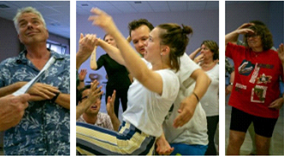
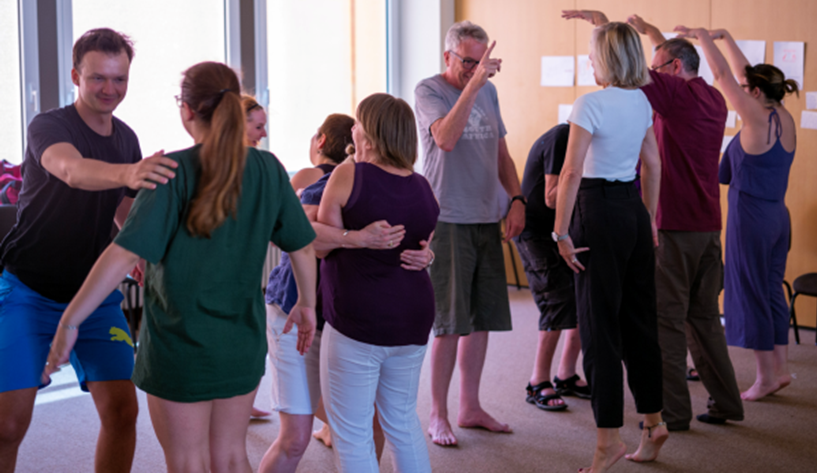
LEATSS is an 8-day residential summer school for amateurs - experienced or otherwise - who wish to develop and improve their practical skills, knowledge, understanding and capabilities.
We emphasise process above product offering structured creative experiences with strong practical outcomes, rather than rehearsing for performance. We thus encompass a wide range of experience, age, experience and skill.
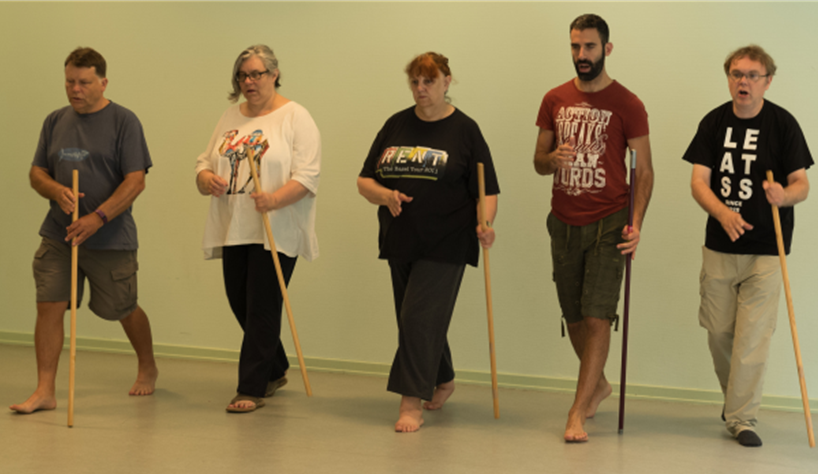
Our tutors are selected for their impressive record as professional theatre practitioners and teachers.
Activity revolves entirely around project work designed to accommodate and integrate the different options offered. Students follow 2 main projects, a shorter creative project as well as general and shared sessions. By the end of the week, everyone should have sampled something of the experience of everyone else.
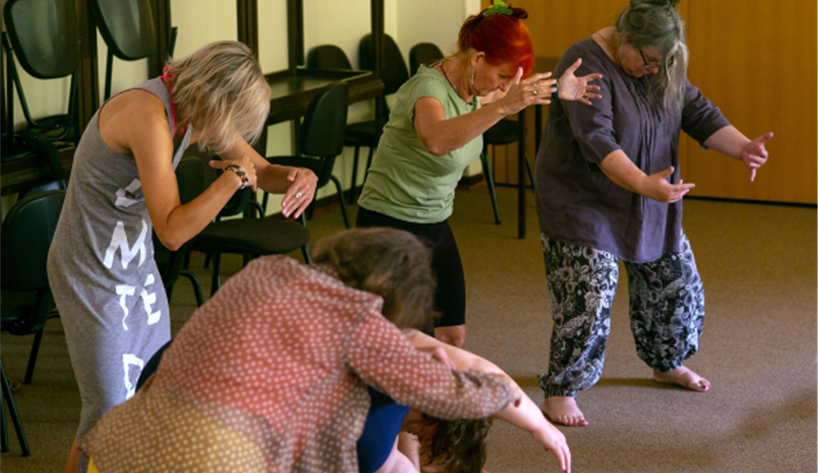
We are active throughout each day, with time off on Thursday afternoon and evening. The pace of work is impressive but rewarding, yet there is also time to relax, assimilate and unwind.
LEATSS is an adult school open to all from age 16 up (although exceptions can be made for under 16’s in certain circumstances).
| When: | Saturday 25th July to Sunday 2nd August 2026 inclusive. |
| Where: | The Clairefontaine Centre d'Accueil on the Belgian-Luxembourg border |
| Fees: | From €1 000 to €1 250 (depending on accommodation) |
Applications online
On the first day of Summer School, students select one option from each of Projects 1 and 2.
| Janice Dunn A New Direction (directing) getting to grips with challenging elements |
| Jack Gogarty So Much More (acting, improvisation) exploring improvisation techniques |
| Georges Ryan Practical Voice (voice for actors) physical and expressive elements of voice |
| Tom Noyes Getting the ‘Feels’ (singing) diving into different musical worlds |
| Janice Dunn and Tom Noyes And a 5, 6, 7, 8! (musical theatre) a co-run course focussing on physicality, character, story and voice and what happens when they collide |
| Jack Gogarty Using the Self (acting) exploring character choices |
| George Ryan Heightened Text (acting) bringing heightened speech into the body |
Summer School starts with lunch at 12:30 on Saturday 25th followed by an introduction to the school, tasters and explanations of the course options, voting for options, and then a session after supper. It ends at 11:00 on Sunday 2nd (12.30 lunch included).
Students can stay at the venue on the night of Friday 24th. This should be indicated in the online application or by prior arrangement with the LEATSS administrator.
Using an 8-point plan as our structure, we will explore some of the most challenging elements of play directing, by actually directing some plays.
Each participant will be assigned or will choose a short section of a play; and over the duration of the course, will have the opportunity to develop themes, character and vision, via a series of directing prompts and interventions.
The participants will serve as actors for each other’s directing work. In this way there is an opportunity to perform, but also to develop as a director through the experience of being directed by others.
You do not need to have directed before to do this course, but a clear understanding of it as a role is advised.
We will be covering use of prompts (techniques), staging issues, text work, character development, physical action, creative integration, dynamics, and noting.
It will be a useful and fun course, accessible to all, but also active and following a tight structure.
(The focus will be on contemporary texts, but participants can bring texts to work on, as long as they have not already directed it, and it is written by a professional writer. Remember, however, that participant numbers are limited.)
This course will be looking at the basics of improvisation while ensuring we don’t censor ourselves.
We will learn to follow impulses, and not just focus on the ‘improv’ trap of ‘being funny’ – although often it will be!
We will then expand further with a character-based, extended form improvisation – the Mike Leigh technique – and explore what it’s like to stay in character for longer periods of time without text.
We will work both in pairs and larger groups, getting comfortable by playing and being silly, whilst exploring how to create entire worlds without anything in the space to help. The techniques of juggling objectives and of scenic goals will be used, alongside literally making everything else up as we go!
Improvisation is so much more than just ‘yes and’.
This course will focus on the physical and expressive elements of voice used in theatre performance. It will be a practical rather than technical course and will allow participants to explore and practise elements of voice and speech as a group, as well as solo as comfort levels grow.
There will be focus on breath, connection between voice & body, and voicing on impulse. We will use a variety of approaches to voice and performance, as well as the practical understanding of physical voice production. A range of physical exercises and approaches, and varying texts will be used to facilitate this process.
The course is suitable for all levels of performer, and no prior experience is required. We engender a space where we are encouraged to voice outside of our comfort zone and test assumptions about our vocal abilities. It will be a supportive and fun environment, full of practical learning. So come and (re)connect to the joy of your own voice!
This course entails going deeper into the musical idioms and techniques that are used in musical theatre, and singing generally.
Great musicals usually draw from these distinctive styles that are then shaped and incorporated into a traditional musical theatre framework. For example: Spring Awakening taking from folk; Oklahoma and Waitress from country; Chicago and Cabaret from jazz; and Phantom and Les Mis taking from the classical tradition.
We can also include Jukebox Musicals, as well as original musicals that co-opt musical styles to conjure a more compelling and authentic musical soundscape.
Practically, what does that mean for performing in a production/ singing live? How do we take these idioms and put them in a theatrical context? We will cover how your versatility as a performer can suit the style of a show, and adapt to different modes of expression.
In short, going deeper into varying musical worlds and working on the fundamental musical building blocks that have informed the creation of the great shows and songs through time.
This course will be practical, active and fun, with bouts of group work. It is suitable for everybody who wants to sing, irrespective of experience, level or ability.
Janice and Tom will be co-running a musical theatre course. This will focus on:
a. Music/ singing/ voice & expression
b. Physicality and movement/ character/ story
c. Most interestingly, what happens when a and b collide.
We will sometimes work together in a full group, and other times individually with half a group each; and we will be working on songs and scenes from a variety of (great) musicals.
The course will examine the technical and expressive demands of both ensemble and solo work in musical theatre. We will also explore some techniques for supporting the demands of performing in musicals.
You do not have to be able to read music, or be dance trained, or even have performed in musicals to do this course. (Though it's also obviously not a disadvantage.) It will however be a physically active course, and people should be prepared for that, within reason. No-one will be expected to sing solo if they don’t wish to.
It will be fun, inquisitive, with lots of useful takeaways on style, techniques, preparation and expression.
We will be exploring character choices for actors, initially by looking at what makes us ‘us’, and what unique and useful qualities we can bring to our characters from within ourselves, rather than cosmetically creating characteristics, and ‘sticking them on’.
We’ll do this through a number of exercises and observations, focussed on revealing character. Then we will explore monologues and duologues and apply the outcomes.
We will also dig into how to approach new text, how to annotate, and make new choices; specifically for monologues, and not make it feel like we are just ‘doing a speech’!
This is perfect for auditions for societies, drama schools, for productions, self-tapes, or simply to expand your actor’s toolbox.
In this bespoke course we will explore areas of heightened text and performance, and experience some of the training and exercises linked to this field.
The focus will be on non-naturalistic texts with heightened forms. These can include stylised modern plays, new writing, or current adaptations of classic plays. It also includes classic works (Greek, Shakespeare, Lorca, etc.) as well as verse plays and performance poetry/ song.
As a group, we will explore texts from plays in various genres, and train ourselves via a series of specific exercises related to the texts in question.
The course will be inspiring, eye opening and enjoyable, and maybe a little challenging at times. It is suitable for all participants, whether they have previous experience of this type of work or not. The classes will take place in a supportive, calm and open group atmosphere.
In spring and autumn LEATSS offers on-line workshops relating to theatre activity
There are no on-line workshops currently planned.
From time to time, LEATSS offers masterclass workshops for residential and day students. These usually last 2 to 3 days and take place during Summer School week, at the same venue, and at the same time as the summer school. The timetable follows that of the Summer School so that breaks and mealtimes coincide.
Prospective students should note that they may participate in the Summer School or a Masterclass but not both. Combining Summer School and Masterclass is not possible.
Two 2-day workshops on Shakespeare (acting, singing), with collaboration between the two groups.
| Tutors: | Mike McCormack and Graeme Du Fresne, both previous LEATSS Course Directors |
| When: | Friday 31st July to Saturday 1st August 2026 |
| Where: | The Clairefontaine Centre d'Accueil on the Belgian-Luxembourg border |
| Fees: | From €300 to €400 (depending on accommodation) |
Applications online
Towards the end of his theatrical career, Shakespeare's company, The King's Men, moved indoors to the Blackfriars Theatre. The new intimacy of around seven hundred spectators, rather than 3,000 or so at the Globe, allowed various changes in the style of writing and performance. In particular, lighting and special effects became possible, while music and song became more intimate and complex along with sophisticated ideas for scene construction.
The course will have two groups, which come together on occasion to share discoveries and work:
MIKE MCCORMACK TEXT AND SCENES (acting)
We will concentrate on two of the late plays: The Tempest and The Winter's Tale, both with exciting elements of the fantastical expressed in playtext and song as well as exploring themes of romance and comedy. While The Tempest exploits the new possibilities of the venue's opportunities for Prospero's and Ariel's magic, The Winter's Tale offers a highly complex plot, with Leontes struggling to come to terms with his own lethal actions.
We will explore some of the wonderfully dramatic moments in these plays as well as look at how to come to grips with the inherent tensions in some of the ‘difficult’ scenes.
We will join the singing group on occasion to share our discoveries and work.
About the tutor: Mike has been an actor, deviser and director and was a creative and inventive Summer School tutor and Course Director, and later, Senior Lecturer in Drama at John Moore's University in Liverpool. He knows well how to integrate concepts and processes into a practical and enjoyable course geared to students with a range of theatrical abilities. LEATSS is pleased to have secured the return of this high calibre tutor who will give students the benefit of his extensive experience and skills.
GRAEME DU FRESNE SONGS AND MUSIC (singing)
Music and song appear throughout Shakespeare’s plays with over 2 000 references to music in the 38 plays as well as more than 100 songs. Very little of the original music exists, either because it wasn’t written down or manuscripts failed to survive for later generations to discover. We do, however, have some written music for songs from the first productions of The Tempest and The Winter’s Tale composed by Robert Johnson (c. 1583–1633), a lutenist and composer who worked for the King’s Men.
The workshop will focus not only on Johnson's songs but also on modern compositions from and inspired by Shakespeare's two plays. Some possibilities are the Beach Boys Good Vibrations from the rock musical The Return to the Forbidden Planet based on The Tempest and songs from Howard Goodhall's musical A Winter's Tale.
We will look at singing technique using exercises and singing rounds of the period, sing arrangements of songs for the ensemble, offer solo opportunities, and explore methods of storytelling through song. We will have serious fun singing, and on occasion, join the acting group to share our discoveries and work.
About the tutor: Graeme has enjoyed a career as stage, film and television actor and was a longstanding and highly popular tutor and Course Director of Summer School. He taught singing at various drama schools in London, was Head of Music at Italia Conti, and is currently working at the London Academy of Drama and Music (LAMDA). He has trained numerous actors who have gone on to impressive stage, film and TV careers, and knows well how to give an engaging and enjoyable course geared to students with a range of singing abilities. LEATSS is very pleased to welcome back this excellent tutor who will give students the benefit of his wide-ranging experience and skills.
Each Masterclass has a total of 14 hours of class: 7 on each day from 09:30 until 21:00 with breaks for tea/coffee, lunch and supper. Students are encouraged to attend the summer school warm-up on both mornings at 09.00.
Every few years, LEATSS offers workhops in other European centres, in collaboration with local theatre groups

No LEATSS on Tour is currently planned